
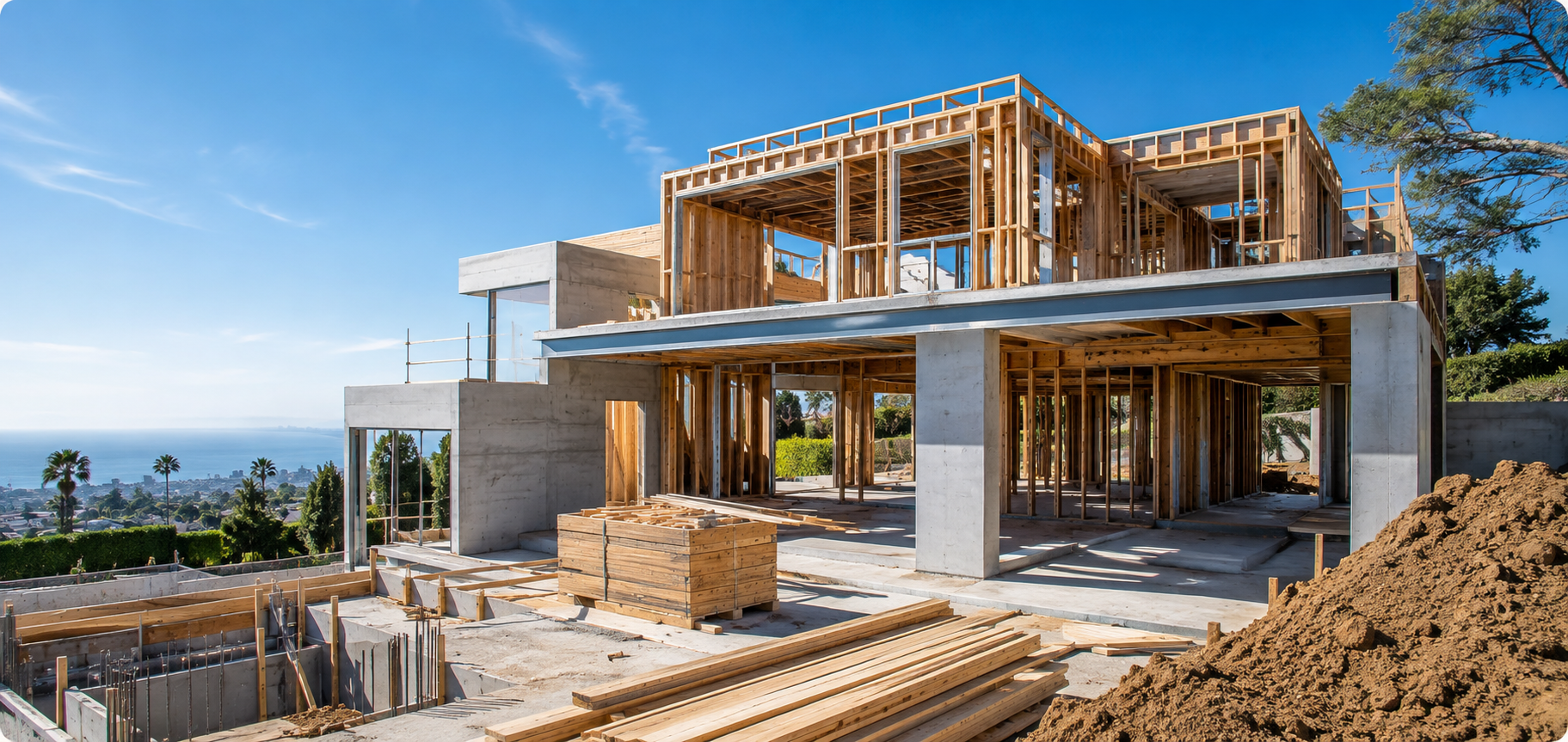
What Is a Ground-Up Construction Loan?
A ground-up construction loan finances the building of a property from raw or vacant land through completion — as opposed to a rehab or bridge loan, which finances improvements to an existing structure. It’s the right tool when a builder or investor owns (or is buying) a lot and needs capital released in stages as the home or project physically comes out of the ground.
Unlike a traditional purchase mortgage, a construction loan doesn’t fund in one lump sum at closing. Because the collateral doesn’t fully exist yet, the lender releases money in a sequence tied to verified construction progress, protecting both the lender and the borrower from paying for work that hasn’t happened.
How Construction Financing Works
At closing, the lender commits to a total loan amount sized against the project’s total cost — land plus hard construction costs plus soft costs like permits, engineering, and contingency. Only an initial small portion (often tied to the land acquisition or site work) funds at closing. The rest sits in a construction holdback that releases over the build in a series of draws.
Before each draw, the borrower or builder submits documentation showing what work has been completed since the last draw. A third-party inspector (or the lender’s own draw administrator) visits the site to confirm the claimed progress matches reality, and funds release once that verification is complete. This keeps the loan balance tied to actual, in-place value at every point in the build.
The Draw Schedule Explained
The draw schedule breaks the construction budget into stages, each with a percentage of funds released once that stage is verified complete. Schedules vary by project size and lender, but a typical single-family ground-up build follows a pattern like the one below.
| Draw | Milestone | Typical % of Budget |
|---|---|---|
| 1 | Site work, foundation, and slab complete | 15–20% |
| 2 | Framing and roof dried-in | 20–25% |
| 3 | Rough plumbing, electrical, and HVAC | 15–20% |
| 4 | Insulation, drywall, and exterior finishes | 15–20% |
| 5 | Interior finishes, cabinetry, and fixtures | 10–15% |
| 6 | Final punch list and certificate of occupancy | 5–10% |
Draws release on verified progress, not the calendar
Every draw requires a site inspection confirming completed work before funds release. Building a few days of buffer into your schedule for each draw keeps cash flow predictable.
Interest-Only Payments During Construction
During the build, borrowers typically make interest-only payments calculated on the outstanding drawn balance, not the full committed loan amount. That means the payment starts small right after closing (when only site work has drawn) and grows with each subsequent draw as more of the loan balance is outstanding.
This structure matters for cash flow planning: a builder isn’t carrying interest on money that hasn’t been disbursed yet. Some programs allow interest reserves — a portion of the loan set aside specifically to cover these payments — so the borrower doesn’t need to service the debt out of pocket during construction.
Builder and Contractor Requirements
Because the lender is underwriting a project that doesn’t exist yet, the builder’s qualifications carry as much weight as the borrower’s. Expect to document the following before closing:
- A licensed, insured general contractor with a track record of comparable builds
- A complete, itemized construction budget matching the appraiser’s cost breakdown
- Approved architectural plans and specifications
- All required permits pulled or in process with the local jurisdiction
- General liability and builder’s risk insurance naming the lender as loss payee
- A realistic draw and completion timeline the lender can underwrite against
Timeline: From Land Purchase to Certificate of Occupancy
A typical ground-up single-family project runs 9–14 months from closing to certificate of occupancy, though larger or custom builds can run longer. Land acquisition and plan finalization often happen before the loan even closes, since most lenders want approved plans and permits in hand at closing rather than mid-construction.
Once the loan closes, site work and foundation typically take 4–6 weeks, framing to dried-in another 6–8 weeks, and the remaining interior build-out and finishes 4–6 months depending on finish level. Building in a contingency — both in budget and in timeline — is standard practice, since weather delays, permitting holdups, and material lead times are common in ground-up work.
Loan-to-Cost (LTC) vs. Loan-to-Value (LTV)
Construction lenders underwrite against two ratios simultaneously, and the lower of the two typically sets your maximum loan amount.
| Loan-to-Cost (LTC) | Loan-to-Value (LTV) | |
|---|---|---|
| What it measures | Loan amount vs. total project cost (land + hard + soft costs) | Loan amount vs. the completed, as-built appraised value |
| Typical max for ground-up | 80–90% of total cost | 65–75% of completed value |
| Why it matters | Controls how much of the borrower’s own cash goes into the build | Protects the lender against overbuilding relative to market value |
| Binding constraint | Usually the limiting factor on experienced-builder deals | Usually the limiting factor in soft or uncertain markets |
Risks and Advantages
Ground-up construction loans give builders and investors financing that a conventional mortgage simply can’t provide — but the structure carries its own set of risks worth planning around before you break ground.
Advantages
- Access to capital for a project that doesn’t yet exist as collateral
- Interest-only payments keep carrying costs manageable during the build
- Draw structure protects the borrower from overpaying a contractor upfront
- Many programs convert to permanent or bridge financing at completion
Risks to plan for
- Cost overruns can outpace the approved budget and require borrower cash to cover
- Delays extend the interest-only period and push back your exit or refinance
- Draw inspections add a few days of lead time before each disbursement
- Contractor performance and licensing issues are the top cause of stalled draws
Contingency isn’t optional
Lenders typically require 5–10% of the hard-cost budget held back as a contingency reserve. Treat it as insurance, not spare capacity — using it up early leaves no buffer for the finishes stage.
Key Takeaways
- Construction loans release funds in a sequence of verified draws rather than a single lump sum at closing.
- Borrowers pay interest only on the drawn balance, which grows as construction progresses.
- Lenders underwrite to both Loan-to-Cost and Loan-to-Value — LTC controls required borrower cash, LTV controls exposure to market value.
- A qualified, insured general contractor and a complete, itemized budget are prerequisites most lenders won’t waive.
- Build in both budget contingency and timeline buffer — overruns and delays are the most common causes of stalled draws.
Frequently Asked Questions
How much down payment is required for a construction loan?
Most ground-up construction loans are underwritten to 80–90% loan-to-cost, meaning the borrower typically contributes 10–20% of total project cost, often including the value of land already owned free and clear.
Do I make full payments during construction?
No — nearly all construction loans are interest-only during the build, calculated on the outstanding drawn balance rather than the full committed loan amount.
How long does a typical draw take to process?
Once a draw request and inspection are submitted, most lenders release funds within 3–7 business days, assuming the completed work matches the draw request.
Can first-time builders get a construction loan?
Yes, though many lenders require a licensed, experienced general contractor of record even if the borrower themselves is a first-time developer.
What happens if my project goes over budget?
Most loans include a contingency line item for this reason. If costs exceed both the budget and contingency, the borrower is typically required to fund the overage out of pocket before the next draw releases.
What is the difference between LTC and LTV in construction lending?
LTC compares the loan to total project cost and controls how much cash the borrower must contribute; LTV compares the loan to the completed appraised value and protects the lender against overbuilding for the market.