
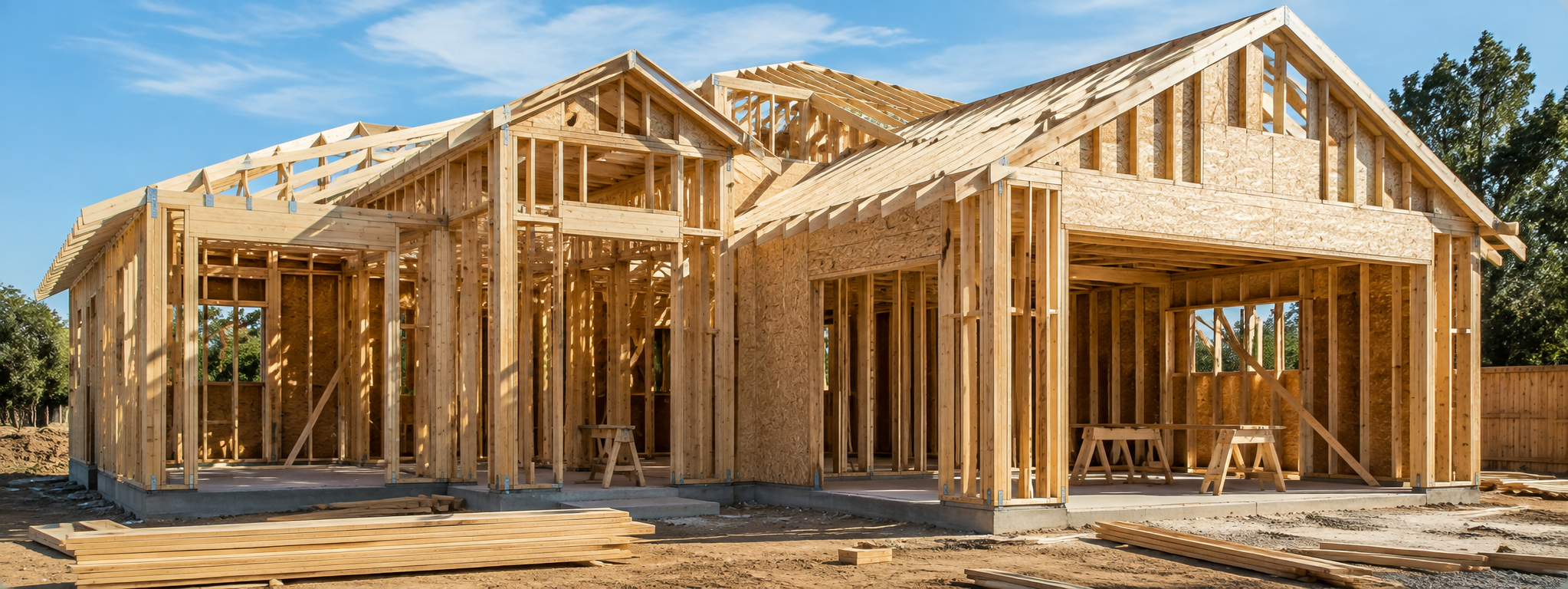
Ground-up construction has always priced higher than permanent financing, but the gap has stretched further than usual over the past two years. Builders financing new construction today are working with materially higher carrying costs than the pre-2022 era, and that reality has changed how draw schedules, interest reserves, and contingency budgets get structured from the first day of underwriting. The projects still getting built aren’t the ones hoping rates come down before completion. They’re the ones built around the rate environment as it actually is.
Why Construction Rates Have Stayed Elevated
Construction loans are floating rate and interest-only during the build, typically priced off SOFR plus a lender spread. With SOFR sitting in the mid 4% range through much of 2026, all-in construction rates have landed in the high 7% to low 9% range for most residential projects, with the exact number shifting by property type and borrower profile. Riskier asset classes such as hospitality price at the higher end, while multifamily construction has generally landed on the more accessible end of that range.
Because the rate floats with SOFR for the life of the build, a project’s financing cost can move in real time as the broader rate environment shifts, which is one reason development activity is so sensitive to rate direction even when a project’s fundamentals haven’t changed at all.
Sizing the Interest Reserve Correctly
An interest reserve is a budget line, funded as part of the loan itself, set aside specifically to cover interest payments through construction and often through a brief lease-up or sale window afterward. In a higher rate environment, this reserve has to carry a meaningfully larger balance to cover the same construction timeline, and getting the sizing wrong in either direction creates real problems. Undersizing it forces a borrower to cover interest out of pocket mid-project. Oversizing it ties up capital that could otherwise reduce the equity requirement elsewhere in the deal.
On a single-family build, builders commonly budget somewhere in the $8,000 to $10,000 range per home as a conservative interest carry allowance at current rates. On larger projects, the number scales accordingly. A $25 million construction loan at an all-in rate near 8.5% can require an interest reserve in the neighborhood of $3.5 to $4.2 million to carry the loan through the build. Regulatory guidance also plays a role here, since depository lenders are required to maintain written standards limiting how heavily a deal can lean on an interest reserve rather than genuine project cash flow.
Interest only accrues on funds actually drawn
A borrower with a $1,000,000 construction loan who has drawn $300,000 pays interest on $300,000, not the full commitment. This is why the pace and size of draws directly controls how much interest accrues early in a project, independent of the stated rate.
How Draw Schedules Are Being Restructured
Because interest accrues only on disbursed funds, the draw schedule itself is now a genuine cost control tool rather than just an administrative sequence. Builders and lenders are leaning toward tighter, more frequent milestone verification instead of a small number of large draws, since a project that sits with a large undrawn commitment isn’t actually saving money, but a project that draws too far ahead of completed work carries interest on capital that isn’t yet earning value in the building.
| Draw | Milestone | Typical Share of Loan |
|---|---|---|
| Draw 1 | Foundation complete | 10% to 15% |
| Draw 2 | Framing and roof complete | 20% to 25% |
| Draw 3 | Mechanical, electrical, and plumbing rough-in complete | Around 20% |
| Draw 4 | Drywall and exterior complete | Around 20% |
| Draw 5 | Substantial completion | Around 15% |
| Final draw | Certificate of occupancy issued | 5% to 10% |
Behind every draw request sits a detailed schedule of values, the line-item breakdown of the full construction budget by trade. A licensed inspector verifies the percentage of work actually complete against that schedule before a draw releases, which keeps the loan balance tied to verified progress rather than a promised timeline. In a high rate environment, lenders are holding to this verification step more strictly, since an idle or overfunded draw carries a real, measurable cost every month it sits unearned.
Contingency and Retainage in a Higher-Cost Environment
Contingency reserves have crept toward the higher end of their historical range as material and labor cost volatility has made budgets harder to lock down for the full length of a build. Where a 10% reserve was once treated as sufficient on many residential projects, more builders are now budgeting into the 15% to 20% range, with the higher end reserved for projects with import-exposed materials or longer build timelines.
| Budget Safeguard | Typical Range | Purpose |
|---|---|---|
| Contingency reserve | 10% to 20% of construction budget | Covers unplanned cost or scope changes |
| Draw retainage | 5% to 10% held back per draw | Released at substantial completion, protects against unfinished work |
| Developer equity requirement | 15% to 35% of total project cost | Reduces lender exposure and loan-to-cost ratio |
Retainage works alongside contingency as a separate safeguard. Rather than releasing the full value of each draw, lenders commonly hold back a percentage, often 5% to 10%, until the project reaches substantial completion. That holdback gives the lender leverage to ensure punch-list items and final details actually get finished rather than left incomplete once most of the budget has already been disbursed.
Capital Stacks Are Getting More Creative
Higher construction debt costs have pushed more developers toward layering additional capital sources into the deal rather than relying on a single construction loan to cover the full budget. Preferred equity, capital that carries a fixed return but doesn’t count as debt for loan-to-cost purposes, has grown sharply as part of construction capital stacks over the past year, since it lets a project move forward with less conventional debt on the balance sheet even at a higher cost of capital. Mezzanine financing is playing a larger supporting role for the same reason, particularly on projects where a bank’s standard loan-to-cost ceiling leaves a funding gap that pure equity would otherwise have to fill.
This layered approach adds complexity to underwriting, but it’s becoming a standard part of how larger ground-up deals get structured while base construction rates remain elevated.
Practical Adjustments Builders Are Making
Beyond the loan structure itself, builders are changing day-to-day practices to keep carrying costs under control while rates stay elevated.
- Timing material deliveries to land within a week or two of installation rather than holding inventory on site, since idle materials still carry financing cost
- Re-baselining the budget against current rates and material pricing on a quarterly basis rather than assuming the original underwriting still holds
- Building explicit interest-carry assumptions into the schedule for each phase, not just a single project-level estimate
- Confirming supplier lead times and pricing at quote acceptance rather than waiting until shipment to learn about delays or escalation
- Favoring pre-sold builds or build-to-rent structures where exit visibility is clearer, over speculative builds with no confirmed buyer or tenant
None of these adjustments eliminate the effect of a higher rate environment on a construction budget, but together they narrow the gap between what a project was underwritten to cost and what it actually costs to complete.
Key Takeaways
- Construction loans price off SOFR plus a lender spread, so financing cost moves in real time with the broader rate environment throughout the build.
- Interest reserves need to carry a larger balance in a higher rate environment, and regulatory guidance limits how heavily a deal can rely on one.
- Because interest accrues only on drawn funds, tighter and more frequent milestone verification has become a genuine cost control tool, not just an administrative step.
- Contingency reserves have shifted toward the 15% to 20% range on many projects, with retainage held back separately until substantial completion.
- Preferred equity and mezzanine financing are playing a larger role in construction capital stacks as developers work around higher conventional debt costs.
Frequently Asked Questions
Does a higher construction loan rate affect the entire loan balance from day one?
No. Since interest accrues only on funds actually drawn, the effective cost early in a project is lower than the stated rate suggests. The impact grows as more of the loan is disbursed over the course of construction.
What happens if the interest reserve runs out before construction is complete?
The borrower typically has to cover ongoing interest payments directly rather than drawing further against the loan. This is one of the main reasons accurately sizing the reserve at the outset matters as much as the construction budget itself.
Is preferred equity the same as a second loan on the project?
No. Preferred equity carries a fixed return like debt, but it’s structured as an equity investment rather than a loan, which means it doesn’t count against the loan-to-cost ratio the same way additional debt would.
Why do lenders hold back retainage instead of releasing the full draw amount?
Retainage gives the lender leverage to ensure a contractor completes punch-list and finishing details rather than moving on once most of the budget has been paid out. It’s released once the project reaches substantial completion.